
How to Choose the Right Solar Panel Wattage For Your RV or Camping Setup

You are parked right on the edge of a stunning canyon in the middle of nowhere. You go to flip on your lights, maybe start a movie, or just keep that 12V fridge humming so your steak doesn't spoil. Then, the dreaded beep happens. Your battery monitor is screaming. Your power is gone. Suddenly, that off-grid dream feels more like a cold, dark nightmare.
The jump from "I want to live off-grid" to "How do I actually power this thing?" is usually where the fun stops and the headaches begin. You start seeing terms like Amps, Volts, and Watt-hours, and your brain just checks out. Most people end up guessing how much solar power they need, which is a recipe for disaster. You either end up with dead batteries by 2:00 AM, or you spend three times more money than you needed to on a massive solar array that your batteries can't even hold.
This guide is going to strip away the confusion. We are going to walk through how to calculate your energy needs, figure out the whole solar panel series vs. parallel debate, and look at some plug-and-play gear that makes the math a whole lot easier.
Key Takeaways
-
Calculate Daily Consumption First: Before buying any equipment, multiply the wattage of your appliances by the hours used to find your total Watt-hours. This tells you whether you need a modest 300W system for basics or 800W+ for heavier use.
-
Always Include a Safety Buffer: Real-world conditions like clouds, dust, and flat roof mounting reduce efficiency. Add a 20-25% buffer to your final calculations to ensure reliable performance.
-
Optimize Wiring for Your Environment: Understanding solar panel series vs. parallel configurations is vital for performance. Use series wiring to boost voltage for better low-light charging, or parallel wiring to ensure your entire system doesn't shut down when a single panel is partially shaded.
-
Consider Portable Power Solutions: If DIY electrical work feels overwhelming, integrated systems like BLUETTI portable power stations simplify the process. They combine the battery, inverter, and controller into one unit, allowing you to plug in high-capacity panels like the PV350 without complex wiring.
Why Is Sizing Your RV Solar Panel Wattage Correctly So Important?
Before we start crunching numbers, we need to get one thing straight about how solar actually works. A lot of folks think solar panels are like a wall outlet at home, where you plug something in, and the panel powers it directly. That is not how it works in the RV world. Your battery bank serves as a gas tank, and your solar panels as the gas pump. The panels exist solely to refill that tank.
The Balance of Power
If your solar array is too small, you'll constantly run into power deficits and may need to rely on a noisy generator.
On the flip side, if you go overboard and install a massive 1,200W array but you only have a tiny battery, all that extra sun is just wasted. Once the battery is full, the solar controller shuts off the flow. Finding the "Goldilocks" zone saves you money and ensures you never wake up to a warm fridge.
Battery Lifespan and Efficiency
Correctly sizing your RV solar panel wattage also protects your investment. If you constantly drain your batteries to zero because you don't have enough solar to recharge them, you are going to kill those batteries fast. Lead-acid batteries hate being low, and even fancy Lithium (LiFePO₄) batteries need a proper charge cycle to stay healthy. Getting the wattage right ensures your system stays balanced and your gear lasts for years instead of months.
How Do You Calculate Your Exact RV Solar Panel Wattage Needs?

You cannot just pick a number out of a hat. A bit of simple energy bookkeeping is the most important part of the whole setup.
Step 1: Calculate Your Daily Energy Consumption (Wh)
Every gadget in your RV uses a certain amount of power. To find out your total daily need, you use a simple formula: Appliance Wattage × Hours Used = Watt-hours (Wh). If you have a 60W laptop and you use it for 6 hours, that is 360Wh. Easy, right?
To help you out, here are some common energy hogs you might find in your rig:
-
12V Fridge: These run 24/7, but the compressor cycles on and off. Expect about 600Wh per day.
-
Laptop: Between charging and usage, plan for about 360Wh per day.
-
LED Lights: If you have 5 lights running for 5 hours, that is roughly 250Wh per day.
-
Water Pump: You only use it in bursts, so maybe 50Wh per day.
Step 2: Factor in Peak Sun Hours and Inefficiencies
Here is where reality hits the fan. A 100W panel does not produce 100W for 12 hours a day. In the real world, we use a metric called "Peak Sun Hours." This is the window of time when the sun is strong enough to actually give you good output. In the US, depending on where you are and the season, you generally get between 4 and 6 peak sun hours.
There is another catch: flat mounting. Most RVers bolt their panels flat to the roof. This is convenient, but it means the panels are rarely at the perfect angle to the sun. You lose about 20% to 30% of your efficiency right there.
Plus, you have to deal with clouds, dust on the panels, and the natural resistance in your wiring. That's why adding a 25% safety buffer is smart.
Step 3: Use the Solar Sizing Formula
Now we put it all together.
The formula is Total Daily Wh ÷ Peak Sun Hours = Required Solar Panel Wattage.
Let's say your total daily math adds up to 1,500Wh. If you get 5 hours of good sun, you take 1,500 divided by 5, which equals 300W. Don't forget the 25% buffer — this brings your target closer to 375–400W.
How Much Solar Does Your Specific Camping Style Require?
Not every camper is the same. Some people just want to keep the lights on, while others are trying to run a mobile office with three monitors and a Starlink dish. Your solar needs should match your lifestyle.
The Weekend Minimalist
If you mostly head out for two or three days at a time, use a cooler for some of your food, and only need power for lights and phone charging, you are in the "low impact" category. You are likely using 1 to 3 kWh per day. For this setup, a modest 200W to 300W array is usually plenty. It keeps your batteries topped off without taking up your entire roof or breaking the bank.
The Extended Traveler or Digital Nomad
This is where many modern RVers land. You are on the road for weeks or months. You have a 12V fridge, you work on a laptop, and you probably have a Starlink dish for the internet. Starlink is a notorious power hog, by the way. Daily usage often falls between 3 and 6 kWh. To keep up with that, you should look at 400W to 800W of solar.
The Full-Time Boondocker
If you live in your RV year-round and refuse to stay in crowded RV parks, you need a powerhouse. You are likely running residential appliances, a microwave, and maybe even a small air conditioner or a heater. Your usage can easily climb to 6 to 12+ kWh per day.
In this case, you need to maximize every inch of your roof. You should be looking at 800W to 1,200W or more. At this level, understanding solar panel series vs. parallel wiring becomes absolutely critical.
Solar Panel Series Vs. Parallel: Which Wiring Configuration is Best?

Once you have your panels, you have to hook them together. This is where people get intimidated, but it's just like putting batteries in a flashlight. The way you wire them changes how the electricity flows to your charge controller.
What Happens When You Wire in Series?
In a series circuit, you connect the positive plug of one panel to the negative plug of the next one. Think of it like a chain. When you do this, the Voltage of the panels adds up, but the Amperage stays the same as a single panel.
One of the biggest pros of series wiring is that the higher voltage helps your MPPT charge controller "wake up" earlier in the morning when the sun is low. It also allows you to use thinner, cheaper wires because the "pressure" (Voltage) is high, but the "flow" (Amperage) is low.
The downside? Shade is your enemy. If a single leaf or a tree branch covers just one corner of one panel, the "flow" through the whole chain is restricted. It's like putting a kink in a garden hose; the whole system suffers.
What Happens When You Wire in Parallel?
In parallel, you use "branch connectors" to connect all the positives together and all the negatives together. Here, the Amperage adds up, but the Voltage stays the same.
The main reason people love parallel wiring is shade tolerance. If one panel is in the shade, the others keep pumping out power at full blast. They act independently. However, the "flow" (Amperage) gets very high. This means you need thick, heavy-duty cables to prevent the wires from getting hot or losing power. You also have to use inline fuses for each panel to stay safe, which adds a bit of complexity to the DIY build.
The Best of Both Worlds: Series-Parallel
If you are building a large system with four or more panels, you don't have to choose just one. You can do both. You might take two panels and wire them in series to get the voltage up, then take another two panels in series, and then connect those two pairs in parallel. This gives you the high-voltage efficiency of series wiring with the shade-protection benefits of parallel wiring. It is the gold standard for anyone installing a high-RV solar panel wattage array.
Skip the DIY Wiring: Upgrade Your RV With BLUETTI
I know what you're thinking — "I just wanted to go camping, not become an electrician." I totally get it. That is why so many people are moving toward portable, integrated solutions.
Maximize Yield with the BLUETTI PV350 Solar Panel

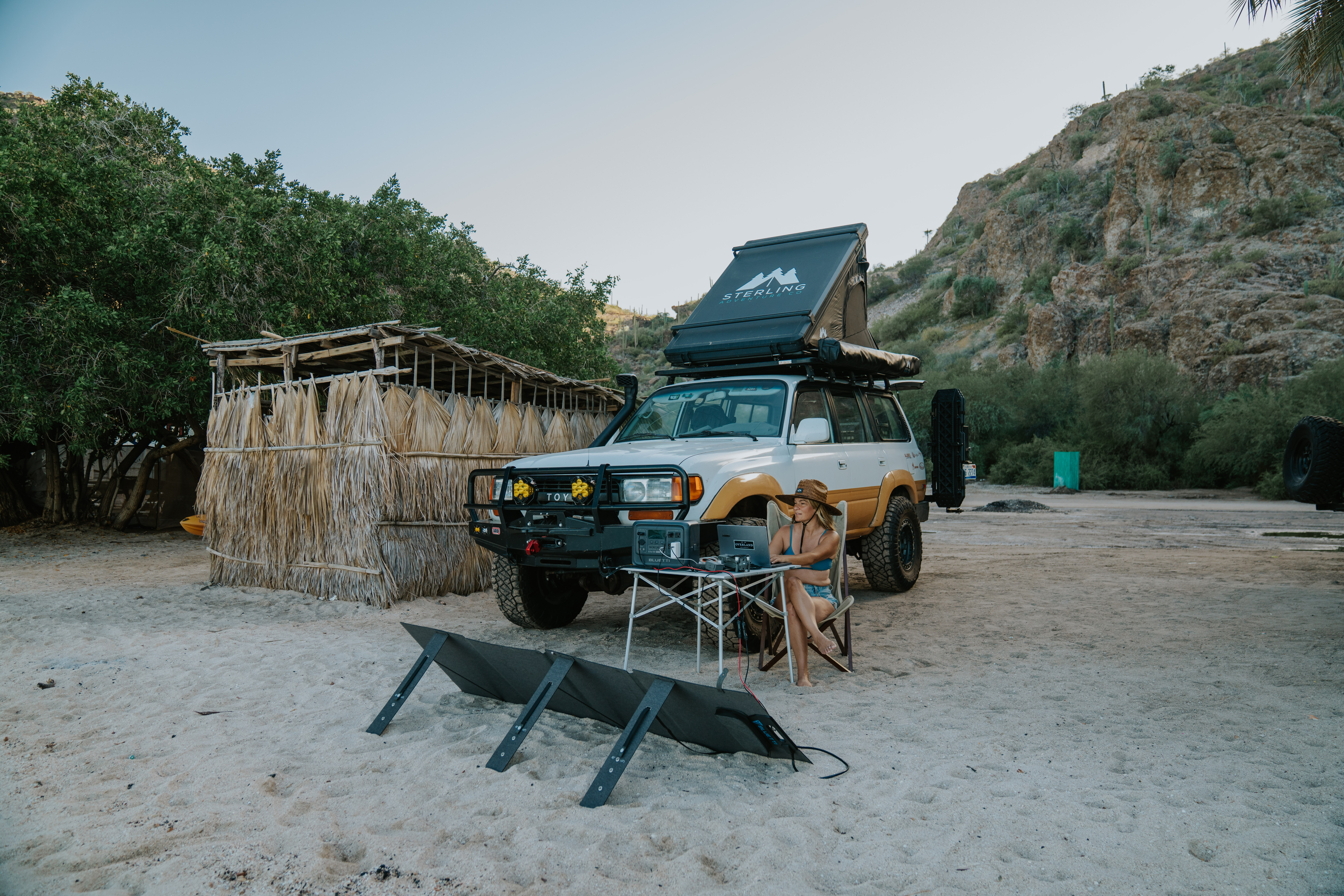
One of the biggest issues with roof-mounted solar is that you have to park your entire RV in the sun to get power. That means your RV gets hot, and your AC has to work harder. It's a losing battle. This is where a portable panel like the BLUETTI PV350 shines. Instead of being stuck on your roof at a bad angle, you can park your rig in the shade and set the PV350 out in the grass, angled perfectly in the sun.
The PV350 is a beast. It offers a massive 350W of Solar Panel Wattage for your RV in a foldable, portable package. It uses monocrystalline cells with a 23.4% conversion rate, which is about as efficient as it gets in this industry. It features an Open Circuit Voltage (VOC) of 47V, which is high enough to trigger most charge controllers easily, even in low light. Plus, it's built to last with an ETFE coating and IP65 water resistance, so a sudden rain shower won't ruin your day.
Replace Complex Wiring with a Portable Power Station
If the idea of drilling holes in your roof and crimping wires makes you sweat, you should look at a portable power station like the BLUETTI AC200L or the Elite 300. These units are basically a "solar system in a box." They house the LiFePO₄ batteries, the pure sine wave inverter, and the MPPT charge controller all in one sleek unit.


BLUETTI AC200L Portable Power Station | 2,400W,2,048Wh
- 1,200W Max Solar Input
- 6 Ways to Recharge
- 3,000+ Life Cycles to 80% Capacity
- Advanced MPPT and Battery Management System
- Ideal for Off-Grid Living and Outdoor Adventures
You don't have to worry about the solar panel series vs. parallel math as much here because these units are designed to handle high input voltages. You literally just plug your PV350 panels directly into the back of the unit. There is no guesswork, no exposed copper, and no risk of blowing a fuse because you used the wrong wire gauge. It turns a weekend-long installation project into a five-minute "plug and play" setup.


BLUETTI Elite 300 Portable Power Station | 2,400W, 3,014Wh
- Frost & Sullivan® Certified —The World's Smallest 3 kWh Portable Power Station
- 1,200W Max Solar Input
- ≤10ms UPS Response Time
- 6,000+ Life Cycles to 80% Capacity
- 3kWh Power at 2kWh Portability
- 11 Versatile Ports for Plug-and-Play Convenience
- TT-30 RV Port — Ideal for Van Life & DIY Setups
Final Words
Getting your power situation sorted brings real peace of mind. When you take the time to calculate your daily Watt-hour usage and choose the right solar setup, you stop being a slave to the battery monitor. You can focus on the reason you went out there in the first place: the views, the quiet, and the freedom.
It doesn't matter if you decide to go the full DIY route or choose the simplicity of a BLUETTI portable system. Grab a notebook, list your appliances, and start building the off-grid setup you deserve. If you want to skip the headache, head over to the BLUETTI website. The PV350 panels and Elite series power stations are excellent options for a reliable setup. Happy trails, and may your batteries always stay full!

Shop Products for This Article


You May Also Like