


DIY Step by Step To Build a Home Battery Backup System?

The absence of a battery backup system in these times can put you and your family in a dire position during emergency situations, such as blackouts, which will only increase with time. A battery backup system will store the excess energy output produced by your solar panels for a safety net during calamities, such as periods of high energy demand, ensuring consistent energy supply that will keep things up and running.


BLUETTI Elite 200 V2 Portable Power Station | 2,600W 2,073.6Wh
- 1,000W Max Solar Input
- 15ms UPS Response Time
- 6,000+ Life Cycles to 80% Capacity
- MPPT Controller, BMS, and More
- Ideal for Home Backup and Outdoor Adventures
Stay One Step Ahead from Everyone with a Battery Backup System
If you’re into DIY, and looking for a battery backup system, look no further as this easily digestible article will provide you every bit of information on building a battery backup system by yourself from the comfort of your home. The important factors discussed are:
- Determining your power needs by calculating individual units in your home and adding them up.
- Choosing the right components for your battery backup system.
- And, some futile mistakes to avoid.
Determining Your Power Needs
Knowing your energy requirements during an outage is the way to start. Common household appliances, such as refrigerators and light bulbs, are some of the essentials that need to be identified and calculated.
Here is a table listing a few common appliances, and their related and starting watts.
|
Household Appliance |
Related Watts |
Starting Watts |
|
Light Bulb |
25-100 |
0 |
|
Ceiling Fan |
75 |
0 |
|
Television |
80 |
0 |
|
Microwave |
600-1000 |
0 |
|
Refrigerator |
700 |
2200 |
|
Air Conditioner |
1500 |
2200 |
|
Washing Machine |
1200 |
2300 |
To be on the safe side, confirm the related and starting watts of the above appliances installed in your home.
Calculate Total Power Consumption
Once you have identified the electrical appliances you will be needing during an outage, make a list of them like the one we’ve made above, and calculate their individual related and starting wattages. Then, add them together depending on how many you will be needing. Not too difficult, eh?
Identify Appliances; Which Ones are Critical
Critical appliances are necessary to sustain a normal life during an outage, although there is nothing normal about such situations. But still, heating and cooling appliances, medical equipment, and security systems, including many others that are vital for your family’s well-being, should be considered. This way, your tailor-made energy requirements will suit your specific needs.
What’s Your Required Backup Capacity?
Now that you’ve identified your energy requirements, it’s time to plan your backup power capacity. Do not underestimate your consumption, always leave a margin. Your battery backup system’s capacity should also include surge capacity alongside running requirements.
Surge capacity is the additional power required by heavy appliances, such as refrigerators and air conditioners, upon starting.
Choosing the Right Battery
The battery is the MVP of your battery backup system, so choose it wisely with great consideration. An entire house battery backup will require you to add multiple battery packs. Now, follow the critical practice of choosing every appliance, and multiplying its power requirements with the amount of time you’ll be using it.
For example, a microwave requires 1,000 W to run. If you’ll be using the microwave for an hour, you will multiply its wattage by one to get its total kWh rating, which will be 1 kWh in this example.
When choosing a battery, it is a good practice to go for one that has twice the total battery backup capacity to your home’s electricity requirements.
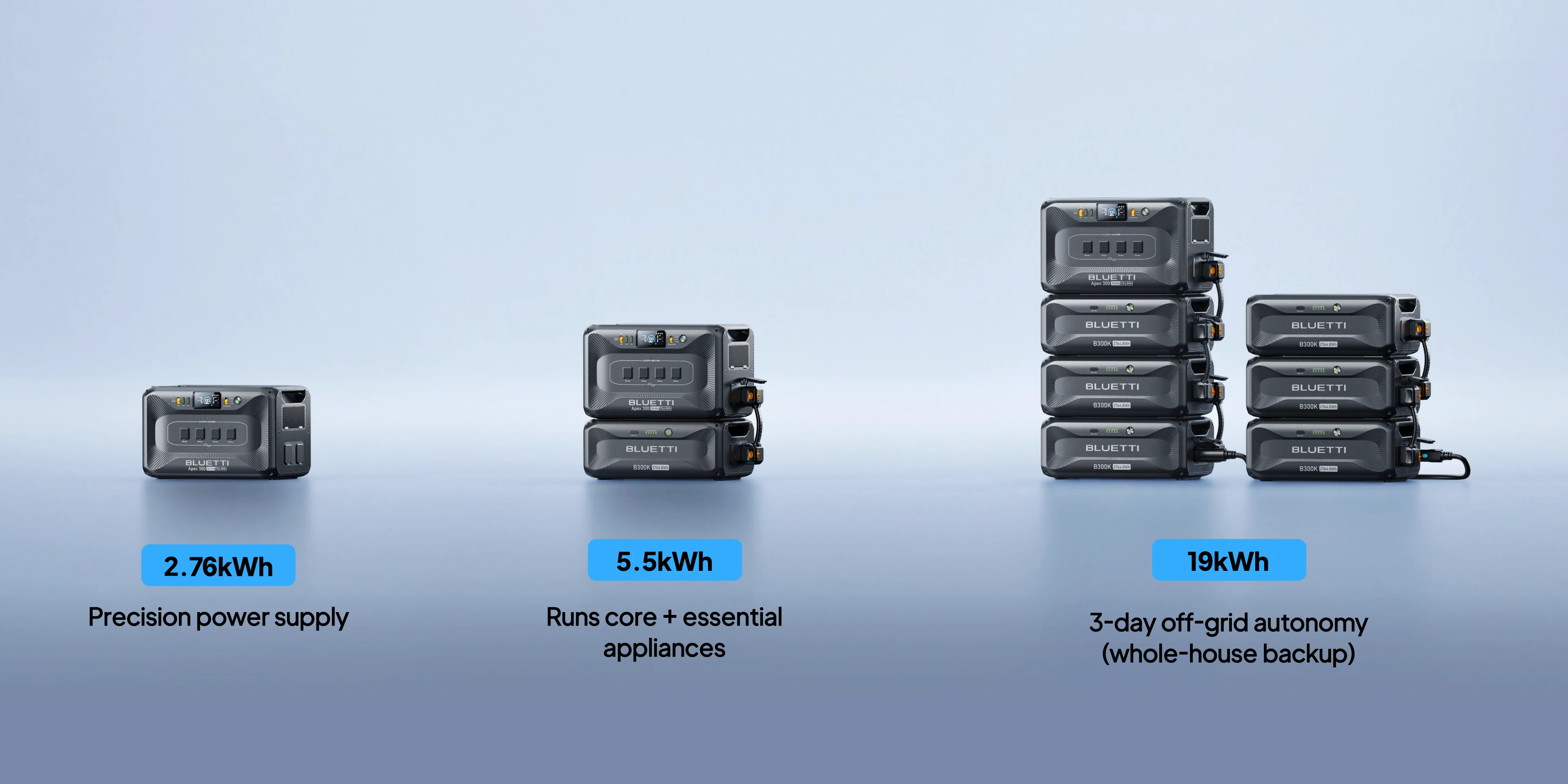
According to our research and experience, the BLUETTI Apex 300 + B300K is the ideal battery for “rolling with a rolling blackout.” It is jam-packed with smart and safety features, fully modular (customizable), and terrifically convenient.

For starters, you can easily control your battery backup system with BLUETTI’s Smart App, which operates via WiFi or Bluetooth connections. With the BLUETTI Apex 300 + B300K, you get a powerful and flexible energy solution for home backup or outdoor use.
The system provides a total capacity of 5,529.6Wh, combining the Apex 300 power station with the B300K expansion battery, ensuring long-lasting power during outages. This abundant capacity can keep essential household appliances running for extended periods when the grid goes down.
Lastly, the 3,840W rated output and 7,680W surge power make the system capable of handling demanding appliances with ease, delivering reliable performance for both everyday use and emergency situations.
In terms of practicality, the BLUETTI Apex 300 + B300K stands out with its versatile charging options. It supports multiple charging methods, including:
-
AC charging
-
Solar charging
-
Generator charging
-
Car charging via cigarette lighter
-
AC + Solar dual charging for faster input
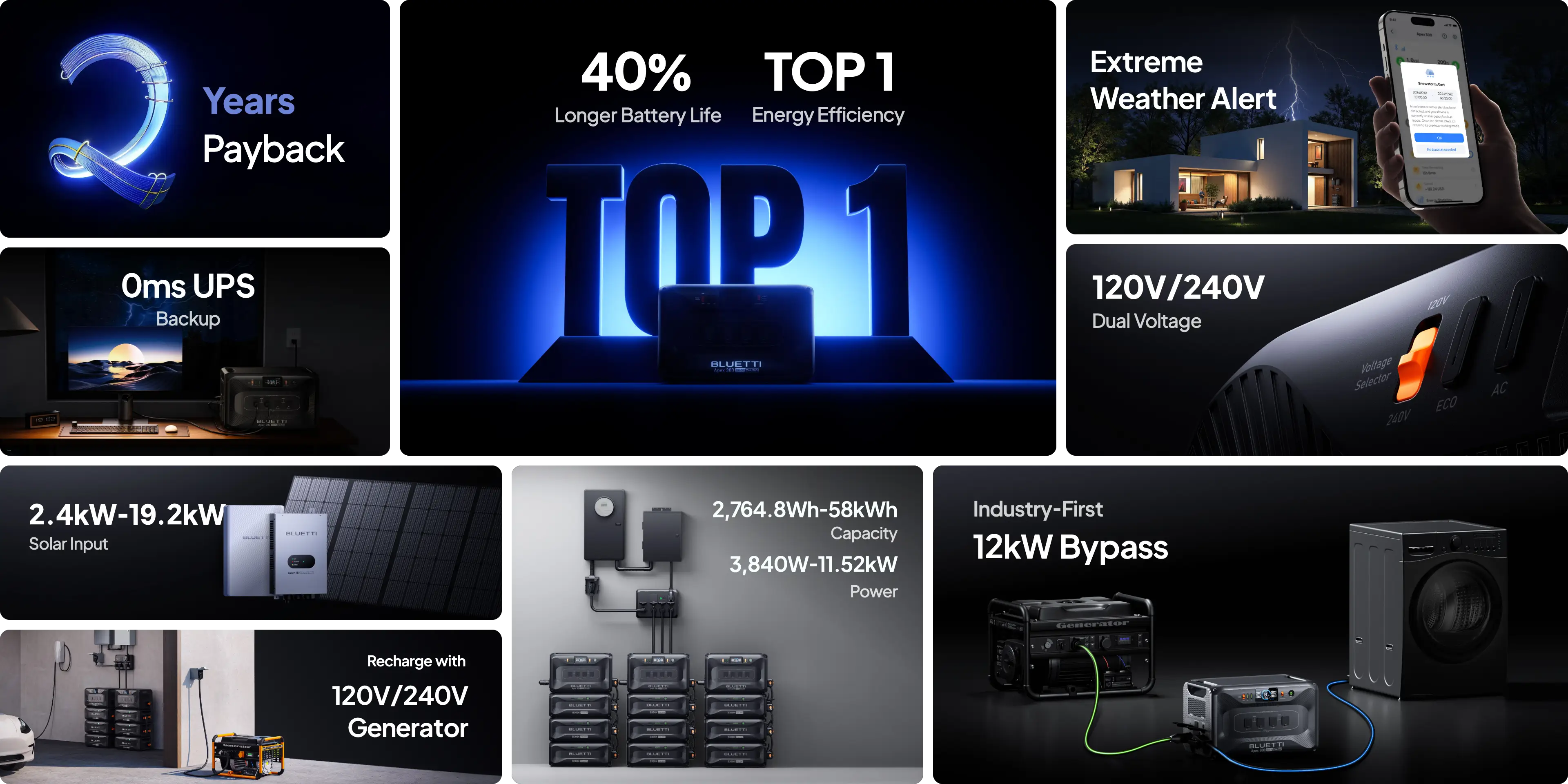
This flexibility ensures you can recharge the system efficiently whether you're at home, on the road, or off-grid.
The B300K LiFePO₄ battery is also built for longevity, delivering over 3,500 charge cycles before dropping to 80% capacity, making it a reliable long-term energy solution.
Additionally, the Apex 300 features a pure sine wave inverter with a 3,840W rated output and up to 7,680W surge power. This ensures stable electricity for sensitive electronics and powerful appliances alike, allowing them to operate smoothly while protecting them from voltage fluctuations and surges.


Apex 300 Versatile Power Station | 3,840W, 2,764.8Wh
- 2,400W Max Solar Input
- 0ms UPS Response Time
- 6,000+ Life Cycles to 80% Capacity
- Dual Voltage Output & Expandable Storage
- Ideal for Smart Home Energy Management
With simple financing options, an immensely competitive price, and a 5-year warranty, this battery backup system is a no-brainer.
Choosing the Right Inverter
Your home’s main plugs dish out alternating current (AC), which runs all appliances. Unfortunately, your battery pack can not charge on AC current as it needs direct current (DC). This is where the inverter comes in. Since you can’t directly plug your battery pack to your home circuit and appliances, you need an inverter to convert the battery’s power into AC.
Now that you’ve calculated your home’s total energy requirements, choose an inverter that matches your battery’s voltage and supports the total wattage of appliances you require. More importantly, choose an inverter that matches the combined surge of all your heavy appliances.
Choosing a Battery Charger
Charging your batteries the proper way is an art, as you want to strike the crucial balance between charging your battery for all your needs, but not overcharging it — overcharging has a negative impact on your battery’s health.
For this, you need a regulator with your battery charger.
Design the System
Now that everything is in place, wire the components together using thick wires and fuses. First, connect the battery to the inverter, charging regulator, and charging source. Finally, connect your battery backup system to your home’s main wiring using a transfer switch.
I recommend you employ professional help to assist you through this process, as it can get a bit tricky, increasing the chances of error that may have detrimental consequences — no one wants to play with electricity.

The following video will be of tremendous help to you in setting up your battery backup system:
Common Mistakes to Avoid in DIY Home Battery Backup System
DIY is a great way to save money and practice your creativity with problem-solving skills; it is far more rewarding as well. However, people confuse DIY with maximizing savings. You need to install high-quality equipment, such as wires and components, that mitigate several risks.
Underestimating Your Consumption
This is where the calculation of your household electricity requirement becomes pivotal. If you underestimate your energy requirements, your backup system will not suffice during an outage. So, it is better to slightly overestimate your energy requirements than underestimating them, as there is no harm in the former option.
Choosing the Wrong Components
A LiFePO4 battery pack is the standard nowadays. It is safer, more effective, less prone to heating, adept to high energy density, charges faster, and longer lasting. Other battery types, including Lithium-ion and Nickel Cadmium, are outdated.
Doing It Yourself Entirely
Since we’re in the world of DIY, doing it yourself is encouraged and should be the case. However, with electricity, several intricacies come into play that can pose numerous risks to you and your family. So, if you’re stuck on a step, or you’re unable to connect the components together and to your home’s main source, acquiring professional help is always recommended.


BLUETTI Elite 400 Portable Power Station | 3,840Wh, 2,600W
- Wheels and handles for easy transport
- High Output: 2,600 W rated, 3,900 W lifting power
- Ultra-low 3 W standby draw extends runtime
- 15 ms UPS switchover during outages
Final Thoughts
Given the deterioration of existing infrastructure of power grids and severe climate change, never has the risk of power outages been greater. To safeguard yourself and your family from this electrical drought, it is imperative that you set up a battery backup system as soon as possible.
If you’re choosing the DIY route, which is widely recommended, ensure you execute every step of the process with prowess. Safety is the utmost priority, so use the best equipment, such as BLUETTI’s Apex 300 + B300K, and never shy away from taking professional help.
You Might Also Like:
| Mini fridge wattage | Generator for food truck | Average electric bill in Ohio | Florida solar incentives | My electric bill doubled in one month | How many watts does a furnace use | Is electricity cheaper at night | Average electric bill in Texas | Average electric bill in Florida | Average electricity bill in California | Whole home battery backup | How many watts to run a house | Business energy switching service | Solar panel cost in Houston, TX | How to get free solar panels from the government in 2023 | Does a computer use a lot of electricity | NV Energy cost per kWh | What size whole house generator do I need | What is blow-by on a diesel | Most affordable solar panels|

Shop Products for This Article


You May Also Like


