
Why Do You Need a Portable Solar Generator for Your Adventures? (2026 Comprehensive Guide)

Modern exploration has changed. You can now power a coffee grinder or essential gear miles from the grid without the noise or exhaust of a gas engine. This quiet, reliable convenience is exactly why you need a portable solar generator on an adventure. It bridges the gap between the rugged outdoors and the comforts of home.
Today, an adventure power solution is essential for everyone, from digital nomads and overlanders to families needing to keep devices and fridges running. This 2026 guide breaks down why these silent, portable units are the most valuable addition to any modern campsite.
Why Is a Solar Generator the Ultimate Upgrade for Your Next Adventure?

The old-school gas generators are a vibe killer. They are heavy, they require you to haul sloshing cans of expensive fuel, and they announce your presence to every living creature within a three-mile radius. A solar generator flips the script. It is essentially a high-tech battery bank paired with an inverter, allowing you to harvest energy from the sun and store it for whenever you need it.
The biggest plus point here is safety and serenity. Because these units don't combust anything to create power, they are completely fume-free. You can actually keep your power source inside your tent or tucked under your van's bed without worrying about carbon monoxide poisoning. It's clean, it's quiet, and it's remarkably efficient.
How does "Electric Camping" redefine roughing it?
People often ask if bringing a massive battery into the woods ruins the point of camping. Honestly speaking, it actually lets you stay out longer. "Electric Camping" isn't about bringing the whole living room; it's about strategic comfort. Imagine hanging high-efficiency LED string lights around your site. They pull less than 30W but transform a dark, spooky clearing into a cozy oasis.
If you're traveling with a group, an outdoor solar power setup lets you host a literal "campsite cinema." With a portable projector and a white sheet, you can watch movies under the stars. Perhaps the best perk is the death of the "ice run." By using a solar generator to run a powered 12V cooler, you eliminate the need for bags of melting ice that turn your hot dogs into soggy sponges. You get consistent, dry refrigeration, which is a total luxury when you're three days deep into the backcountry.
Why is silent power critical for medical and creative needs?
For many, a power source isn't just about luxury; it's a non-negotiable health requirement. If you or a travel partner uses a CPAP machine for sleep apnea, the outdoors used to be off-limits or incredibly stressful. A portable solar unit can power a CPAP machine silently all night long. There's no engine vibration to keep you awake and no noise to annoy the campers in the next plot over. It provides peace of mind that your medical gear will stay active until the sun comes up.
Then there are the creators. If you are a photographer or a drone pilot, you know the "battery anxiety" that hits when you see that final red bar. An off-grid camping generator allows you to fast-charge drones, cameras, and laptops right in the field. You can offload your footage and get back in the air without having to drive back to civilization to find an outlet. It turns the wilderness into a fully functional mobile studio.
How Do You Choose The Right Power Size For Your Trip?
Picking a generator is like picking a backpack: if it's too small, you can't fit what you need; if it's too big, you're just carrying dead weight. To get it right, you need to look at watt-hours (Wh). This number tells you how much total energy the battery holds. A quick pro-tip: always add a 20% to 25% buffer to your calculations. Between the energy used to convert DC to AC and the natural loss in the wires, you'll want that extra breathing room so you aren't left in the dark.
Is the BLUETTI Elite 30 V2 enough for a minimalist weekend?

If you are a solo traveler or a couple who just wants to keep the essentials running, a compact unit like the BLUETTI Elite 30 V2 is a fantastic entry point. It packs a 288Wh capacity and a 600W output. To put those numbers into perspective, you could recharge a standard smartphone about 16 times. If you're just using it for illumination, it can run a 10W camping light for nearly 25 hours straight. It's light, grab-and-go, and perfect for those who want to stay connected without lugging around a heavy suitcase.


BLUETTI Elite 30 V2 Portable Power Station | 600W 288Wh
- 30dB Quiet Operation at 200W
- 10ms UPS Response Time
- 8 Ways to Recharge
- 3,000+ Life Cycles to 80% Capacity
- Ideal for Daily Use and Outdoor Adventures
Why is the BLUETTI Elite 100 V2 the "Goldilocks" choice for families?

For those who don't want to compromise, the Elite 100 V2 is often the "just right" solution. With 1,024Wh of capacity and a beefy 1,800W output, this is where you start entering "home replacement" territory. This unit is a standout for family trips because it can handle 90% of your common household appliances.


BLUETTI Elite 100 V2 Portable Power Station | 1,800W 1,024Wh
- Easy-to-Carry: Only 25lbs with a 17L design and hidden handle
- 10ms UPS Response Time
- 4,000+ Life Cycles to 80% Capacity
- Lightweight and Portable (Only 25 lbs)
- Ideal for Camping and Home Backup
- Induction Burners: Make breakfast without touching a propane tank.
- Kettles: Rapidly boil water for your morning French press.
- Mini-Fridges: Store eggs and milk all week long.
Portable solar generators have sufficient advantages to serve a medium-sized group for a few days, particularly when you combine them with panels to keep the juice flowing.
How Do BLUETTI Solar Panels Provide "Perpetual Power" Off-Grid?
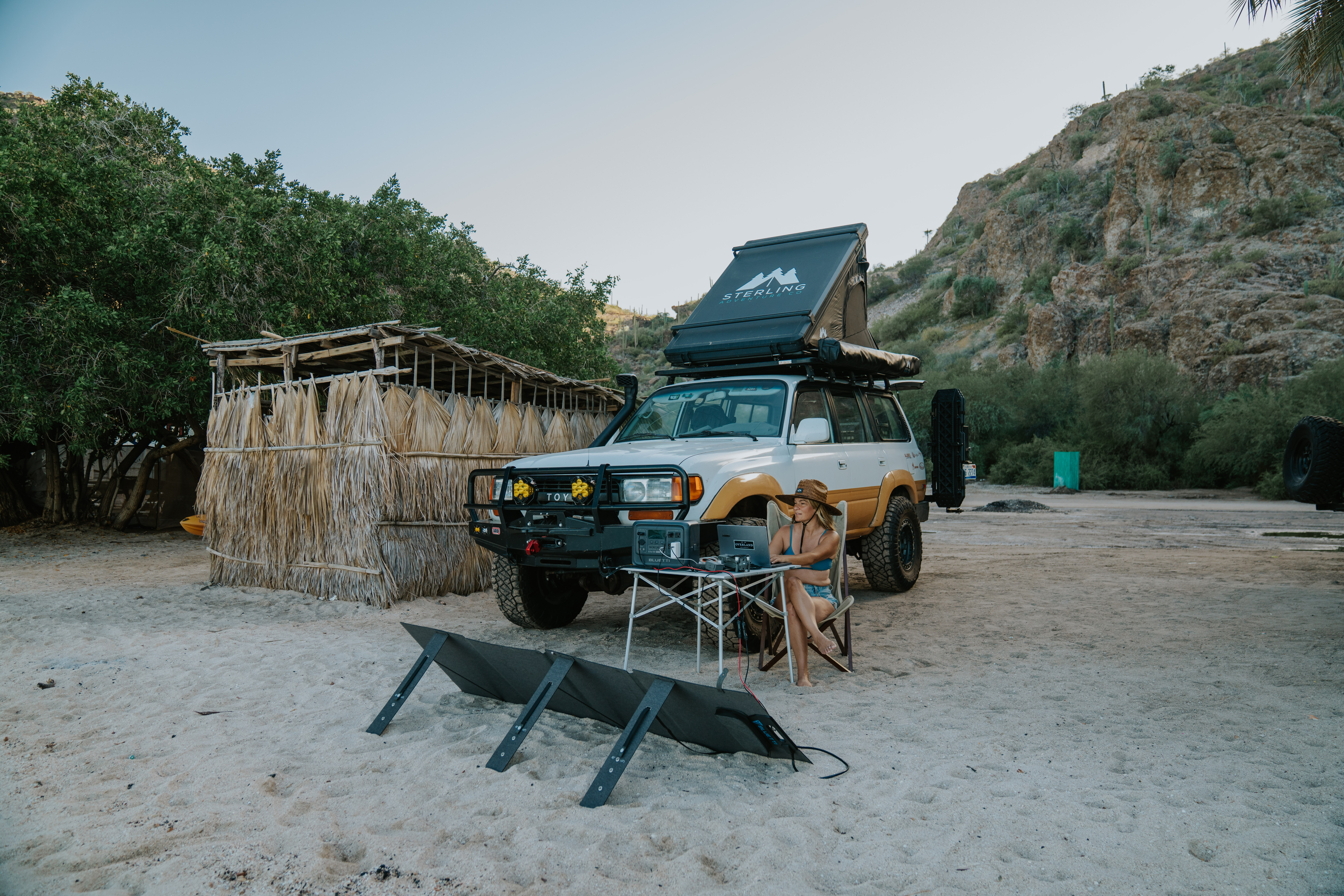
The "generator" part of the name is actually a bit of a misnomer; it's a battery until you plug in the solar panels. That's when the magic happens. Solar panels transform your power station from a limited reservoir into a self-sustaining ecosystem. As long as the sun is shining, you have a path to infinite energy. This is the ultimate adventure power solution because it removes the "ticking clock" from your trip. You don't have to head home just because your battery hit 10%.
Should you choose 100W or 200W solar panels?

Choosing your panel wattage depends on your "fuel tank" size. If you are using a smaller unit like the Elite 30 V2, a 100W panel is perfect. It's lightweight, easy to move, and provides plenty of current to top off a small battery throughout the day. However, if you have moved up to a 1,000Wh or 2,000Wh station, you really want the 200W panels. They are the "sweet spot" for larger units, providing enough input to significantly recharge the battery even during the shorter light hours of autumn or winter.


BLUETTI SP100L Solar Panel | 100W
Up to 23.4% Solar Conversion Efficiency
Durable ETFE-Coated Solar Cells
Foldable & Portable Design
Compatible with MC4 Solar Generators
12-Month Warranty


BLUETTI 200W Portable Solar Panel
200W Solar Power Output
Up to 23.4% Conversion Efficiency
IP67 Water Resistance
Foldable & Portable Design
Ideal for Camping, Fishing & Hiking
What factors affect your solar charging speed in the wild?
It's important to manage expectations here: solar isn't a "plug and forget" deal like a wall outlet. Real-world efficiency fluctuates based on a few key factors. Shading is the biggest enemy; even a single tree branch casting a shadow across one corner of a panel can slash your intake by half. Clouds obviously slow things down, and the angle of the sun matters immensely.
To get the most out of your outdoor solar power setup, you should point your panels directly at the sun and adjust them every few hours. Also, pay attention to the cables. Using high-quality XT60 connectors helps minimize energy loss during the transfer from the panel to the battery. It's all about squeezing every drop of Vitamin D into those cells.
Can A Solar Generator Handle The "Rough" Parts Of Adventure?

Adventure isn't always sunshine and smooth roads. Sometimes it's washboard gravel, sudden downpours, and freezing nights. If your gear can't handle a little abuse, it doesn't belong in your rig. Many people worry that these high-tech boxes are too fragile for the "real" outdoors, but modern engineering has come a long way.
What makes the Elite series durable for overlanding?
BLUETTI uses automotive-grade LiFePO₄ (Lithium Iron Phosphate) cells. Unlike the lithium-ion batteries in your phone, these are much more stable and can withstand thousands of charge cycles. To protect those cells, the Elite series features a unibody design with aluminum frames. This construction is designed specifically to handle the vibrations of rocky trails and the occasional "oops" drop while unloading the trunk. It's built to be a tool, not a delicate ornament.
What happens when the temperature drops?
Standard lithium batteries have a secret weakness: they hate the cold. If the temperature hits freezing, many batteries stop accepting a charge or lose their capacity rapidly. This is a huge problem for ski trips or late-fall expeditions.
However, technology is evolving. If you're a true four-season adventurer, you might look toward something like the BLUETTI Pioneer Na. This unit uses sodium-ion technology, which is a total game-changer for winter. While other batteries are shivering, these units can continue discharging even when the mercury hits -25°C. It means your heater stays on and your lights stay bright even in a blizzard.


BLUETTI Pioneer Na(Sodium) Portable Power Station | 1,500W 900Wh
- 1,500W AC Output / 2,250W Power Lifting Mode
- Cold-Proof Charging down to −15°C
- Reliable Power Output down to −25°C
- 0–80% Recharging in 35 Minutes
- 4,000+ Sodium-Ion Battery Life Cycles
Speeding Up: How To Recharge While You're On The Move?
We've talked a lot about the sun, but what if you're driving all day through a storm? Or what if you forgot to charge the unit before you left the house? You shouldn't have to rely solely on the sky or a wall outlet. Your vehicle is a rolling power plant, and you should be using it.
How does the BLUETTI Alternator Charger speed up travel days?

Most people try to charge their power stations using the 12V cigarette lighter port in their car. The problem? It's painfully slow. It's like trying to fill a swimming pool with a squirt gun. This is where the BLUETTI Alternator Charger (specifically the Charger 2) comes in. It hooks directly into your vehicle's charging system and can provide up to 1200W of power. That is roughly 13 times faster than a standard 12 V cigarette-lighter port. By the time you drive from one campsite to the next, your battery could be completely topped off.
Turbo-charging for last-minute trips?
To be completely honest, the contemporary charging capability of the Elite 100 V2 can charge 80 percent within 45 minutes only. That is approximately the same time that it takes to pack your cooler and check your sleeping bags twice. That's a huge time-saver for the rest of us who always pack at the last minute.
FAQs
Can I use third-party solar panels with BLUETTI?
Absolutely. You aren't strictly locked into one brand's ecosystem, which is great if you already have some panels lying around. The main thing you need to check is the Open Circuit Voltage (Voc). As long as the voltage of your panels falls within the range supported by the power station, and you have the right MC4 connectors (which are the industry standard), you are good to go. Just make sure you don't exceed the station's maximum input voltage, or you might fry the internals.
Is it safe to leave my solar generator in my tent or van?
Yes, it is perfectly safe. Unlike a gas-powered off-grid camping generator, solar units produce zero emissions. There is no exhaust, no carbon monoxide, and no smell of gasoline. Furthermore, these units are equipped with a Battery Management System (BMS). This "brain" constantly monitors the temperature, voltage, and current. If things get too hot or if there is an electrical spike, the BMS will automatically shut the system down to prevent damage or fire. It's much safer than a propane lantern or a wood stove.
Final Words
The question of how you can survive without power is not really what you will want to consider when you look at the landscape in 2026; it is rather how much more you can do with it. Having your equipment operational to ensure you have cold beer and your camera is charged, the fact that the portable solar generator has you back is too good to pass up. It is a bet on your liberation. It lets you go deeper into the wild, get lost, and recount those experiences to the people you love without worrying about your battery dying.
That is why when you next head out on vacation, you should consider the silent strength of the sun. It is reliable, it is free, and it is at your beck and call to utilize it. A solar generator is the choice in case you are ready to avoid worrying about battery bars and pay attention to the stars.

Shop Products for This Article


You May Also Like