
Portable Power Station 1000W: Benefits, Limitations, What It Can Run, and More

A portable power station for 1000W hits the sweet spot between size, price, and output. It powers small tools, charges devices, and keeps essentials running during outages. It's reliable and hassle-free.
A 1000W unit is quiet, light, easy to carry around, and does not break your wallet or your back like the bigger models. We'll share in this guide what a power station of 1000W can actually accomplish, how long it can keep your appliances going, and how it performs daily. At the end, you will know if the 1000W unit is what you need or not and whether to continue searching!
Understanding 1000W Power Stations
A 1000W power station is a powerful portable appliance to charge devices when camping and enjoying outdoor recreational resources. It also acts as a backup if you're experiencing an electricity failure in the house on a small scale. Three fundamental terms are useful in knowing how the unit functions:
- Stable Power (max 1000W): This is what the station can keep up with without breaking down. Think of it like its cruising speed. It powers multiple appliances at once, as long as their total draw stays under 1000W.
- Surge Power: There are appliances, such as fridges or motorized tools, that require an additional jolt in order to start. That's the surge. A 1000W station can sustain even the bursts of about 2000W when an appliance switches on.
- Battery Capacity (Wh or kWh): The capacity tells you how much energy the battery can stash. More capacity means longer run times. Depending on the application, the 1000W stations can run tiny appliances for several hours, as they contain about 1000Wh of capacity.
The 1000W portable power stations are light, clean, and quiet, unlike the gas generators. They operate quietly without vapors. Therefore, they may be used in indoor places, such as tents or living rooms. These units do not need any maintenance, fuel, oil, or spark plugs as well and function immediately with a plug-and-play option.
Wattage vs. Watt-Hours
Knowledge of the distinction between watts (W) and watt-hours (Wh) is important to use a portable power station. Here's how:
- Watts (W) is a measure of the power, such as the strength of output, or what types of devices it can operate. As an example, one can have a 1000W power station, and any device can be supported provided it has a power of 1000W or less.
- Energy storage, such as the duration of operation of devices, is measured in watt-hours (Wh). A 100W device can be operated on a 1000Wh battery approximately (100W x 10h = 1000Wh).
Surge Power Importance
A lot of appliances in homes and workshops require additional power to be started. As an example, a fridge and a freezer may use 2-3 times the usual power. Devices such as a saw and a drill require an enormous jump to start operating. TVs or stereos can also spike for a brief moment when they are on.
With less surge capacity in a power station, it may cut off or open its safety breaker, even if the operating power in the device is less than 1000W. To avoid such, newer models are equipped with features like X-Boost or other surge-support tech. These systems allow the power station to energize spurts of increased power, like running a 1400W coffee maker on a 1000W system. Thus, they are more flexible to varying devices.
Short Comparison Context: Where 1000W Sits
Portable power stations come in a range of outputs. 1000W is the best tradeoff between mobility and power. They fill the gap between the 500W and 2000W models as mentioned beneath:
- ~500W Tier (Light Usage): A 500W station is all you would need to simply charge your cell phone, computer, or camera, or possibly to power a small light or mini-fridge. It can be used when doing casual camping or when one is going out on a weekend.
- ~1000W Tier (All-Purpose): The 1000W power station is the sweet spot for the majority of individuals. It has the capability to operate a small-sized refrigerator, a coffee machine, a TV, or a microwave briefly. When you have more camping to do, are facing blackouts, or just require a little more juice for your jobsite, then grab 1000W.
- ~2000W+ Tier (High Power): Now we're talking serious power. This tier has no trouble operating an air conditioner, hair dryer, or space heater. They are heavier, bigger, and costly. But when you are in need of a backup source for the house or something to use on your RV or in your workshop, 2000W and up is the way to go.
What Can a 1000W Portable Power Station Run?
A 1000W station having an average 1000Wh battery would provide about 850Wh of usable electricity if you take into account the efficiency loss. The following are the approximate operating wattages of the most used appliances and their estimated runtimes when you power them up with a 1000W power station. You'll also learn whether the unit is compatible with a particular appliance:
| Device | Typical Wattage (Running) | Estimated Runtime (1000Wh Battery) | Compatibility | Key Notes |
| Smartphone Charger | 10-20W | 42 - 85 hours | Yes | Extremely efficient. Can charge dozens of times. |
| Laptop | 60-100W | 8.5 - 14 hours | Yes | Can power and charge most models for a full workday. |
| LED Lights | 5-15W | 56 - 170 hours | Yes | Can run multiple lights for days on a single charge. |
| Wi-Fi Router & Modem | 10-30W | 28 - 85 hours | Yes | Critical for staying connected during an outage. |
| CPAP Machine | 30-60W (without humidifier/heated tube) | 14 - 28 hours | Yes | Crucial for emergencies. Check if a 12V DC cord is available for longer runtime. |
| 12V Car Cooler / Fridge | 40-60W | 14 - 21 hours | Yes | Very efficient. Cycling in nature extends the runtime significantly. |
| Home Mini Fridge | 70-150W (300W+ surge) | 5.6 - 12 hours (continuous) | Yes | Check surge power. Make certain the station's surge (e.g., 2000W) can handle the compressor startup. |
| Table Fan / Box Fan | 20-100W | 8.5 - 42 hours | Yes | Excellent for providing comfort and air circulation. |
| Small TV (32") | 30-50W | 17 - 28 hours | Yes | Perfect for entertainment during a blackout or at a campsite. |
| Coffee Maker | 600-900W | 0.9 - 1.4 hours | Yes | High wattage, but suitable for short bursts to make coffee. |
| Electric Grill / Hot Plate | 800-1200W | < 1 hour (marginal at best) | Marginal | A 1200W model will trip the station. A 900W model may function, but drains the battery in ~1 hour. |
| Hair Dryer | 1200-1800W | N/A | No | Exceeds the continuous power rating and will cause the station to shut down. |
| Microwave | 1000-1500W | N/A | No | Even a 1000W microwave has a startup surge that will likely overload the station. |
| Space Heater | 750-1500W | N/A | No | Standard 1500W models will overload it. Low-wattage (500W) personal heaters may function. |
| Toaster / Electric Kettle | 1200-1800W | N/A | No | These are pure high-wattage resistive loads and are incompatible. |
Benefits and Use Cases of a 1000W Station
A 1000W power station falls in between the huge generators and the tiny power banks. Here's how it benefits you:
- Lightweight and Transportable (20–30 lbs): The majority of 1000W models are light (with integrated handles) and so can be transported between a residence and car, camping location, or event.
- Rapid and Flexible Charging: You can charge the 1000W station quickly using a wall outlet (1–2 hours), off-grid solar panels, or your car port on the road.
- Tranquil and Emissionless: Because the 1000W unit is silent and does not produce fumes, it may be utilized inside tents, homes, or businesses.
- Easy, No-Maintenance Design: It's plug-and-play with no need for fuel, oil, or upkeep. Just turn the unit on and attach your devices to it.
- Clean Output: The 1000W station offers a steady and clean sine electrical power that operates sensitive devices such as laptops, CPAP equipment, and audio systems.
Main Applications of a 1000W Power Station
The following are the popular applications for a 1000W portable power station:
- Camping & Tailgating: Your camping and tailgating trips can be upgraded with a 1000W station. You can connect speakers, have the cooler on, prepare a cup of coffee, make some drinks in the blender, or even use a projector to watch movies outside. Smaller units just can't support all that.
- Residential Blackouts: When the power goes out at home, this thing keeps the essentials going—Wi-Fi, lights, phones, laptops, the fridge, and even medical gear like a CPAP. It keeps everything powered for hours.
- RV & Van Life: It's ideal for off-road and road trips. It can power fridges, water pumps, cooktops, and entertainment systems. And it can be charged via solar when staying long without any hookup.
- Mobile Work & Creative Projects: It powers equipment, video cameras, lighting, and sound equipment without making as much noise as a gas generator, which is ideal in a workplace or when shooting outside.
- Outdoor Events & Hobbies: It can power up community events, hobbies, or markets, sound systems, lights, or small appliances with ease.

Restrictions of a 1000W Unit and Tips for Maximizing Its Usage
Although a 1000W station is powerful, it also has constraints associated with it. It cannot run the following equipment:
- Air Conditioners: Even little window units need great starting surges, which would deplete the battery in less than two hours.
- Space Heaters: The 1000W unit might trip or break down if a space heater of 750-1500W is operated on it continuously.
- Kettles & Toasters: Both of them operate between 1200 and 1800 W, which is greater than the 1000W limit of the station.
- Hair Dryers: They may have a heat capacity of 1500W and above, depending on their heat configurations, which is way beyond a 1000W station's limit.
- Large Microwaves: Exceed the station's output and have high surges.
- Irons: Clothing irons lie between 1000-1500W, and can take the unit to its maximum limits.
Maximize the Usage and Runtime of a 1000W Unit
Though a 1000W unit has scarce energy, you can maximize its usage and runtime. Here's how to do that:
-
Give Priority to Energy-Saving Devices
The best option to get a longer battery life for your 1000W unit is to choose low-power alternatives. Get rid of power-grabbing devices. As an example, one should always use a French press, not a coffee maker; a slow cooker, not an electric grill; and LED lights, but not incandescent bulbs.
-
Avoid Consistent High Loads and Max Capacity Strain
The power station operates near its 1000W peak for long periods and will generate heat that will also reduce its life cycle. To achieve the most, maintain your regular power consumption of 80% (around 800W) or less. This allows for little surges and allows the station to endure longer.
-
Perform Regular (But Simple) Maintenance
Maintaining a 1000W portable power station does not demand much upkeep, but there are some patterns that would allow your unit to be more durable. Semi-charges are alright with lithium batteries. Therefore, attempt to maintain the range at 20% and 80% for daily use. When storing for 2 or 3 months, charge to an approximation of 60% and store in a cool, dry place. Moreover, dust the vents in order to make certain they don't get overheated.
-
Employ Solar Recharging for Extended Off-Grid Usage
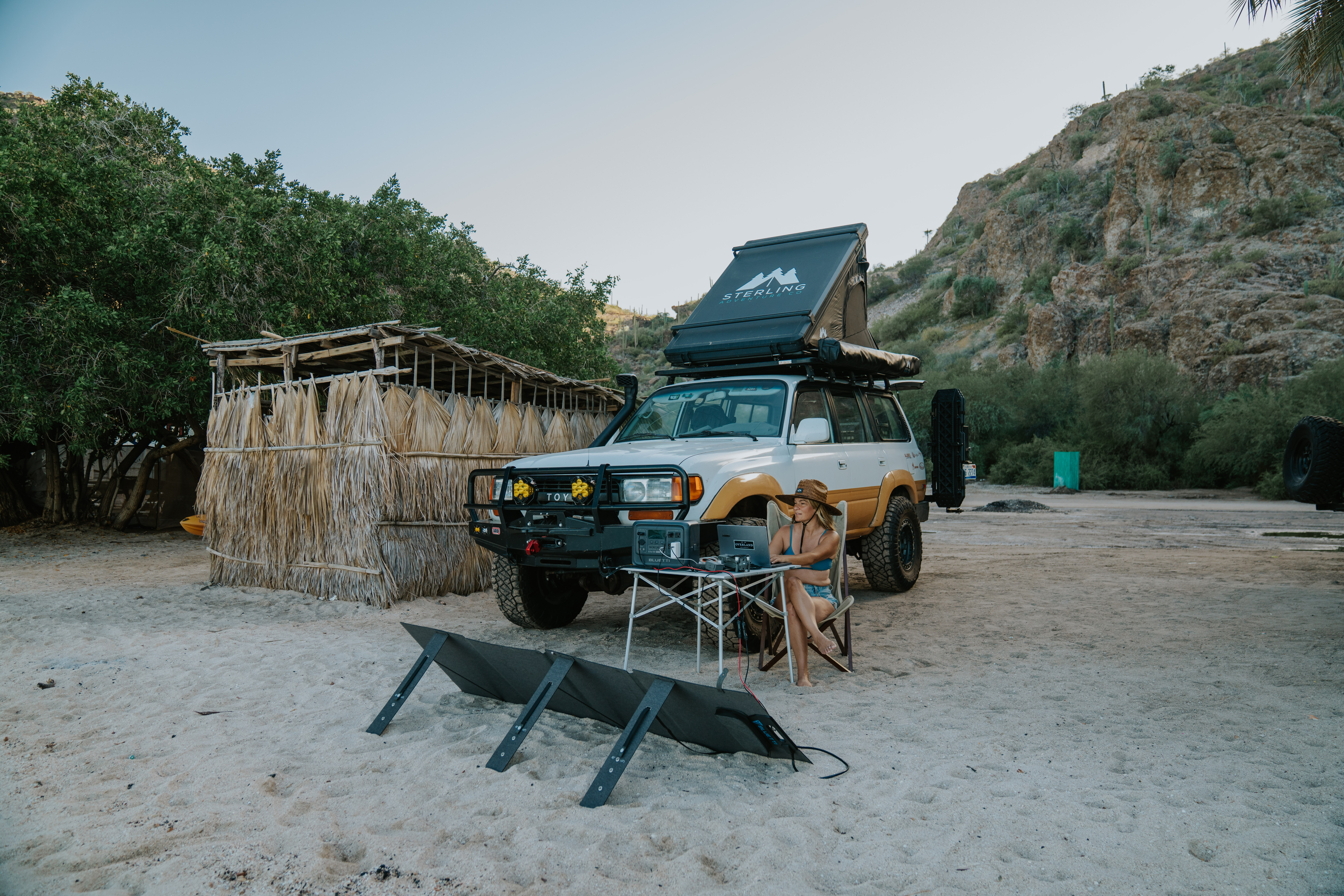
A sustainable setup can be created by connecting your power station with solar panels. A majority of 1000W units are effective with 200-400W panels (max PV input of 25V to 60V).
A 200W panel on a sunlit day can produce between 150 and 170 watts. What it means is that the unit should be able to charge fully in 6-8 hours. You will reduce that charging time by half if you employ the 400W panels.
Quick Tip: The maximum solar input of your power station should always be checked in voltage and wattage to hook up some panels. In that manner, you will not run the risk of ruining your equipment.
-
Calculate Your Needs Before You Go
In a bid to prevent overloads, retain your total device power at or below 1000W. For example:
Runtime Formula: (Battery Wh × 0.85) ÷ Device Watts = Estimated hours
A 60W fan + 150W fridge = 210W total (safe to run)
Runtime: (1000 × 0.85) ÷ 210 ≈ 4 hours
The fridge will be switched on and off. Hence, the time of operation will be augmented.
-
Manage High-Surge Devices
If you need to run a device with a strong startup surge, like a fridge, plug it in by itself first. Let it start running before adding other devices, as this helps prevent the power station from shutting off.

Recommended Power Station Solutions
The BLUETTI Elite 100 V2 is a current higher-output portable-power alternative for readers whose measured device requirements exceed the 1000W category. It provides 1,800W output and 1,024Wh capacity. Compare each device's running watts, starting surge, and required runtime before choosing a model.
Appliances Running Time With BLUETTI Elite 100 V2
1,024 Wh × 90% × 90% ÷ (Load + 10 W) ≈ h
| Appliance | Running Watts | Running Time |
| Several Lights (LED/CFL) | 500W | 1.63 h |
| TV & Electronics | 200W | 3.95 h |
| CPAP | 40W | 16.59 h |
| Phone Charger | 90W | 8.29 h |
| Laptop | 60W | 11.85 h |


BLUETTI Elite 100 V2 Portable Power Station | 1,800W 1,024Wh
- Easy-to-Carry: Only 25lbs with a 17L design and hidden handle
- 10ms UPS Response Time
- 4,000+ Life Cycles to 80% Capacity
- Lightweight and Portable (Only 25 lbs)
- Ideal for Camping and Home Backup
The Bottom Line
A portable power station at 1000W provides good energy, size, and convenience to use on a daily basis, for camping, or as an emergency backup. It is able to rev up most small appliances and runs silently without gas or fumes. You can run lights, a fridge, a fan, maybe even a medical device for hours. Just do not think that it will run heavy-duty devices, as that's not what it's designed for.
For readers who need more output than the 1000W category, the BLUETTI Elite 100 V2 is a current 1,800W alternative. Confirm the connected devices' running watts, starting surge, and required runtime before selecting a setup.
Frequently Asked Questions
When your CPAP is 30W, then you will get approximately 28 hours of run time. Switch on the heated humidifier or tubing, and that drops to about 14 hours. A DC converter is needed to increase the run time and should be used together with the heating off to minimize power wastage.

Shop Products for This Article

You May Also Like